

The x64 architecture (also known as AMD64 or Intel 64) is the 64-bit extension of the x86 instruction set.
It powers modern operating systems and applications, providing access to vastly more memory and additional registers compared to 32-bit x86.
Modes of Operation#
The x64 processor introduces new operational modes while maintaining backward compatibility with x86.
Long Mode (Native 64-bit Mode)#
- The
native modeof x64 CPUs for 64-bit operating systems. - Provides access to the full 64-bit address space and extended registers.
- Memory segmentation is largely disabled in favor of flat memory model.
- Used by modern 64-bit operating systems (Windows 10/11, Linux distributions, macOS).
Compatibility Mode (Sub-mode of Long Mode)#
- Allows
32-bit and 16-bit programsto run on 64-bit operating systems. - Programs execute as if running on a 32-bit processor.
- Transparent to the application - no recompilation needed.
- Example: Running old 32-bit games on Windows 11.
Legacy Mode#
- When 64-bit extensions are disabled, processor behaves like traditional x86.
- Includes Protected Mode, Real-Address Mode, and Virtual-8086 Mode.
- Rarely used in modern systems except during boot process.
Basic Execution Environment#
Address Space#
- In
64-bit mode, applications can theoretically address16 exabytes (2^64 bytes)of memory. - In practice, current processors implement
48-bit virtual addressing, allowing256 terabytesper process. - Physical memory support varies by processor but can exceed
1 terabyte. Compatibility modemaintains the 4 GB limit for legacy applications.
Basic Program Execution Registers#
x64 significantly expands the register set compared to x86, providing more storage for improved performance.
64-bit General-Purpose Registers#
RAX RBX RCX RDX RBP RSP RSI RDI R8 R9 R10 R11 R12 R13 R14 R15
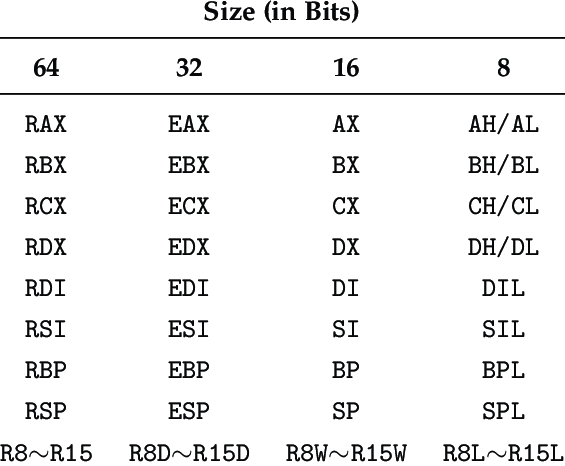
Each 64-bit register can be accessed in multiple sizes:
| 64-Bit | 32-Bit | 16-Bit | 8-Bit (Low) | 8-Bit (High) |
|---|---|---|---|---|
RAX | EAX | AX | AL | AH |
RBX | EBX | BX | BL | BH |
RCX | ECX | CX | CL | CH |
RDX | EDX | DX | DL | DH |
Extended registers (R8-R15) have different naming conventions:
| 64-Bit | 32-Bit | 16-Bit | 8-Bit (Low) |
|---|---|---|---|
R8 | R8D | R8W | R8B |
R9 | R9D | R9W | R9B |
R10 | R10D | R10W | R10B |
R11 | R11D | R11W | R11B |
R12 | R12D | R12W | R12B |
R13 | R13D | R13W | R13B |
R14 | R14D | R14W | R14B |
R15 | R15D | R15W | R15B |
Pointer and index registers:
| 64-Bit | 32-Bit | 16-Bit | 8-Bit (Low) |
|---|---|---|---|
RSI | ESI | SI | SIL |
RDI | EDI | DI | DIL |
RBP | EBP | BP | BPL |
RSP | ESP | SP | SPL |
Specialized Uses of General-Purpose Registers#
RAX: Return values and accumulator operations (64-bit version of EAX).RCX: Loop counter and 4th argument in Windows x64 calling convention.RDX: I/O operations and 3rd argument in Windows x64 calling convention.RSP: 64-bit stack pointer (critical for stack operations).RSI/RDI: String operations source/destination and function arguments.RBP: Frame pointer for accessing local variables and parameters.R8-R15: Additional general-purpose registers, often used for function arguments.
Calling Conventions (Major Difference from x86)#
Microsoft x64 Calling Convention (Windows)#
- First 4 arguments passed in registers:
RCX,RDX,R8,R9 - Additional arguments passed on stack (right to left)
- Shadow space: Caller allocates 32 bytes on stack for called function
- Return value in
RAX - Volatile registers:
RAX,RCX,RDX,R8,R9,R10,R11
System V AMD64 Calling Convention (Linux/Unix)#
- First 6 arguments passed in registers:
RDI,RSI,RDX,RCX,R8,R9 - Additional arguments passed on stack (right to left)
- Return value in
RAX - Volatile registers:
RAX,RCX,RDX,RSI,RDI,R8,R9,R10,R11
Segment Registers#
- Segmentation is largely disabled in 64-bit mode.
CS,SSare still present but function differently.FSandGSare used for special purposes like Thread Local Storage (TLS).DS,ESare ignored in 64-bit mode.
Instruction Pointer#
- The
RIP registercontains the 64-bit address of the next instruction. - Supports RIP-relative addressing - a new addressing mode unique to x64.
- Instructions can reference data relative to the current instruction pointer.
RFLAGS Register#
- 64-bit version of the EFLAGS register.
- Contains the same status and control flags as x86.
- Additional bits reserved for future use.
Status Flags (Same as x86)#
CF (Carry flag): Set if unsigned arithmetic overflow occurs.OF (Overflow flag): Set if signed arithmetic overflow occurs.SF (Sign flag): Set if result is negative.ZF (Zero flag): Set if result is zero.AF (Auxiliary Carry): Set for BCD arithmetic operations.PF (Parity flag): Set if result has even parity.
Common Assembly Instructions#
The fundamental instructions remain the same but operate on 64-bit operands:
mov — Move data between registers, memory, or immediate values.
mov rax, rbx        ; Move 64-bit value from rbx to rax
mov eax, ebx        ; Move 32-bit value (zeros upper 32 bits of rax)
mov ax, bx          ; Move 16-bit value
mov al, bl          ; Move 8-bit value
add — Addition operation.
add rax, rbx        ; 64-bit addition
add rax, 1000       ; Add immediate value
sub — Subtraction operation.
sub rsp, 40 ; Subtract from stack pointer (common for stack allocation)
inc / dec — Increment/decrement by 1.
inc rcx             ; Increment 64-bit register
dec r8              ; Decrement extended register
lea — Load Effective Address (very powerful in x64).
lea rax, [rdi + rsi*2 + 8] ; Calculate address using complex addressing
cmp — Compare operands (sets flags for conditional jumps).
cmp rax, 0          ; Compare with zero
cmp r8, r9          ; Compare two registers
REX Prefix#
x64 instructions may require a REX prefix byte to:
- Access extended registers (R8-R15)
- Specify 64-bit operand size
- Access new 8-bit registers (SIL, DIL, BPL, SPL)
mov r8, rax         ; Requires REX prefix
mov sil, al         ; Requires REX prefix for SIL
Addressing Modes#
x64 supports all x86 addressing modes plus RIP-relative addressing:
Register Addressing#
mov rax, rbx ; Source operand is in register rbx
Immediate Addressing#
mov rax, 0x12345678 ; 32-bit immediate (sign-extended to 64-bit)
Memory Addressing#
mov rax, [rbx]              ; Direct memory reference
mov rax, [rbx + 8]          ; Base + displacement
mov rax, [rbx + rcx*2]      ; Base + index*scale
mov rax, [rbx + rcx*2 + 8]  ; Base + index*scale + displacement
RIP-Relative Addressing (New in x64)#
mov rax, [rip + 0x1234]     ; Load from address relative to current instruction
lea rbx, [rip + data_label] ; Load address of label relative to RIP
The Stack (64-bit Behavior)#
The stack operates the same way as x86 but with important differences:
- Stack grows downward: From high addresses to low addresses
- LIFO behavior: Last In, First Out
- 64-bit addresses: All stack operations use 64-bit pointers
- 16-byte alignment: Stack must be aligned to 16-byte boundaries before function calls
Stack Instructions#
push — Push 64-bit value onto stack (decrements RSP by 8).
push rax            ; Push 64-bit register
push qword [rbx]    ; Push 64-bit memory value
pop — Pop 64-bit value from stack (increments RSP by 8).
pop rax             ; Pop into 64-bit register
pop qword [rbx]     ; Pop into 64-bit memory location
Stack Frame Setup (64-bit)#
; Function prologue
push rbp            ; Save old frame pointer
mov rbp, rsp        ; Set new frame pointer
sub rsp, 32         ; Allocate space for local variables

; Function epilogue
mov rsp, rbp        ; Restore stack pointer
pop rbp             ; Restore old frame pointer
ret                 ; Return (pops return address into RIP)
call instruction pushes 8 bytes, so you often need to adjust RSP by additional 8 bytes.The Heap (64-bit Considerations)#
- Larger address space: Can allocate much more memory than 32-bit systems
- Same principles: Dynamic allocation with malloc()/free() or new/delete
- 64-bit pointers: All heap addresses are 64-bit values
- Same vulnerabilities: Buffer overflows, use-after-free, double-free still apply
// 64-bit heap allocation
long long *big_array = malloc(1000000 * sizeof(long long)); // 8MB allocation
free(big_array);
Conditional Jumps#
Conditional jumps work identically to x86, but operate on 64-bit comparisons:
cmp rax, rbx        ; Compare 64-bit values
je equal_label      ; Jump if equal
jne not_equal       ; Jump if not equal
jg greater          ; Jump if rax > rbx (signed)
ja above            ; Jump if rax > rbx (unsigned)
All x86 conditional jump instructions are available with same mnemonics.
Basic Examples#
Stack Frame (64-bit Version)#
Let’s examine the same C program compiled for 64-bit:
#include <stdio.h>

int M = 5; // Global variable

int add_func(int var) {
    int L = 0; // Local variable
    L = M + var;
    return L;
}

int main() {
    printf("The result is %d\n", add_func(1));
    return 0;
}
Compile in 64-bit mode:
gcc -m64 stack_frame.c -o stack_frame_x64
Verify the format:
file stack_frame_x64
stack_frame_x64: ELF 64-bit LSB pie executable, x86-64...
x64 Assembly Analysis:
Function Prologue:
push rbp            ; Save old frame pointer (64-bit)
mov rbp, rsp        ; Set new frame pointer
sub rsp, 16         ; Allocate 16 bytes for locals (aligned)
Accessing Global Variable M:
mov eax, DWORD PTR M[rip] ; RIP-relative addressing for global
Accessing Function Parameter:
- Linux (System V): Parameter in
ediregister (first argument) - Windows: Parameter in
ecxregister (first argument)
; Linux version
mov edx, edi        ; Parameter 'var' passed in EDI register
Performing Addition:
add eax, edx        ; Add M + var
mov DWORD PTR [rbp-4], eax  ; Store in local variable L
Function Return:
mov eax, DWORD PTR [rbp-4]  ; Move L into return register
leave               ; Equivalent to: mov rsp, rbp; pop rbp
ret                 ; Return to caller
Key Differences from x86:#
- Registers are 64-bit: RBP, RSP instead of EBP, ESP
- Parameter passing: Uses registers instead of stack for first few arguments
- RIP-relative addressing: Global variables accessed relative to instruction pointer
- Stack alignment: 16-byte alignment requirements
- Return address: 8 bytes instead of 4 bytes
Advanced x64 Features#
Position Independent Code (PIC)#
RIP-relative addressing enables PIC, crucial for modern security:
lea rax, [rip + data_section]  ; Address calculated at runtime
mov rbx, [rip + global_var]    ; Access global data relatively
Address Space Layout Randomization (ASLR)#
- x64’s large address space makes ASLR more effective
- Code, stack, and heap can be randomized across vast address ranges
- Makes exploitation significantly harder
No-Execute (NX) Bit#
- Hardware support for marking memory pages as non-executable
- Stack and heap are typically non-executable by default
- Prevents many code injection attacks
Performance Improvements#
More Registers#
- 16 general-purpose registers vs 8 in x86
- Reduces memory access and improves performance
- Better register allocation by compilers
Improved Calling Conventions#
- Register-based parameter passing is faster than stack-based
- Reduced memory traffic for function calls
Larger Address Space#
- No more 4GB memory limitations
- Applications can use system memory more effectively